
Waist-to-height ratio calculator
Keep your waist to less than half your height. That is NICE’s advice for adults with a BMI under 35. Divide your waist by your height: 0.4 to 0.49 is healthy, 0.5 to 0.59 means increased health risk, and 0.6 or more means high risk.
Example: at 5′6″ (168 cm), half your height is 84 cm, or about 33 inches.
Waist-to-height ratio calculator
For adults with a BMI under 35. Use the same units for both, or let the calculator convert.
Runs in your browser. Nothing you type is sent or stored.
How to measure your waist the NICE way
- 1NICE: midway between the bottom of the ribs and the top of the hips, usually just above the belly button
- Lowest rib · Top of hip bone
Approximate position on a 3D body. Breathe out naturally before reading the tape.
NICE encourages adults to measure their own waist-to-height ratio and sets out the method:
- Find the bottom of your ribs and the top of your hips.
- Wrap a tape measure around your waist midway between those points. For most people this is just above the belly button.
- Breathe out naturally, then take the reading.
- Measure your height in the same units and divide waist by height.
This is not where your trousers sit, which for many people is lower and gives a smaller number. Keep the tape level all the way round and snug without pressing into the skin. For consistent readings, measure at the same time of day, ideally in the morning before breakfast.
Half your height, at a glance
| Height | Waist under (cm) | Waist under (inches) |
|---|---|---|
| 5'0" (152 cm) | 76.2 cm | 30.0 in |
| 5'2" (158 cm) | 78.8 cm | 31.0 in |
| 5'4" (163 cm) | 81.3 cm | 32.0 in |
| 5'6" (168 cm) | 83.8 cm | 33.0 in |
| 5'8" (173 cm) | 86.3 cm | 34.0 in |
| 5'10" (178 cm) | 88.9 cm | 35.0 in |
| 6'0" (183 cm) | 91.5 cm | 36.0 in |
| 6'2" (188 cm) | 94.0 cm | 37.0 in |
What the bands mean
Waist-to-height ratio is a quick estimate of central adiposity, the fat stored around your middle. NICE uses it alongside BMI because BMI cannot tell where fat sits. A higher ratio is linked to type 2 diabetes, high blood pressure and cardiovascular disease.
If your ratio is 0.5 or more, NICE’s advice is to seek advice and further checks from a healthcare professional, such as a cardiometabolic risk check. Your GP or a pharmacy health check can do this. NICE also notes that a person with a healthy BMI can still carry weight centrally, so the ratio is worth checking even if your BMI looks fine.
If you are tracking a change
Waists respond to weight loss, activity and age, and they often change when the scale does not. If you are on a weight-loss jab, see what to measure on weight-loss jabs. If you are a Vitality member, your waist can decide whether a BMI of 25 to 29.9 counts as healthy: see the Vitality healthy waist rule.
Questions people ask
What is a healthy waist-to-height ratio in the UK?
NICE classes 0.4 to 0.49 as healthy central adiposity with no increased health risk, 0.5 to 0.59 as increased, and 0.6 or more as high. In plain terms: keep your waist to less than half your height.
Does the waist-to-height ratio work for women and men?
Yes. NICE says the same bands apply to adults of both sexes and all ethnicities with a BMI under 35, including people with high muscle mass. That is one advantage over separate waist cut-offs for men and women.
Why does it not apply if my BMI is 35 or more?
NICE recommends measuring and using waist-to-height ratio in adults with a BMI below 35, and its bands are written for that group. If your BMI is 35 or more, talk to a healthcare professional about how your risk is assessed.
Can I use it for my child?
Not this calculator. The bands here are for adults. NICE points to the NHS waist-to-height ratio calculator for children and young people aged 5 and over.
Should I measure in centimetres or inches?
Either, as long as height and waist use the same unit. 38 inches divided by 67 inches and 96.5 cm divided by 170 cm both give 0.57. This calculator converts for you.
Your body in 3D
Half your height, on a body
Add your height, weight and waist to see a body with your ratio from Contura’s 3D model. Measure every week or two in the app to watch it move.
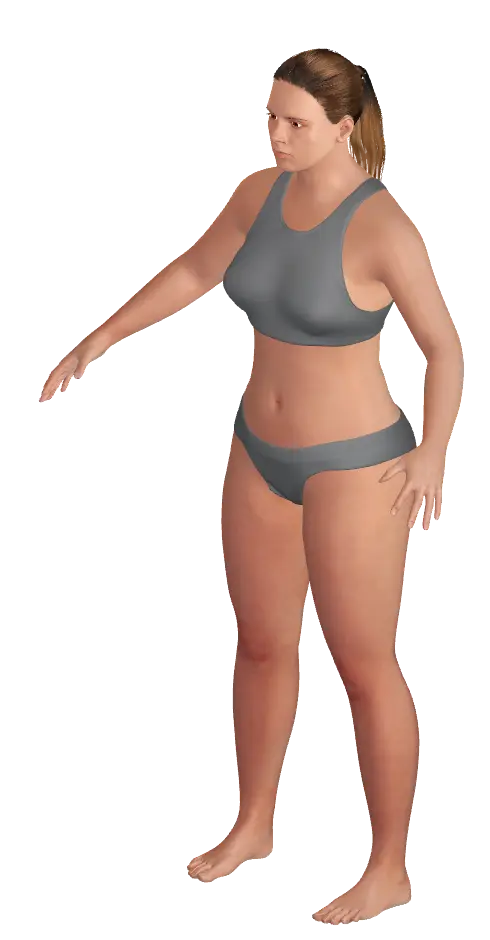
This preview is an estimate from a parametric 3D body model. It is not a body scan or a medical assessment.
What you can measure. All on one body.
- Weight
- Neck
- Chest
- Waist
- Thigh
- Shoulder girth
- Arm
- Wrist
- Hip
- Calf
Left and right · Your own spots
Turn it around in the app
In Contura this body turns any way you like. Log your measurements each week and it changes with you, so you can put any two dates side by side.
Download ConturaSources
- NICE guideline NG246: Overweight and obesity management, section 1.9 National Institute for Health and Care Excellence, published 14 January 2025, last updated 8 January 2026