
Biometric screening waist measurement: the 40 and 35 inch lines
Plans that score waist usually set the line at 40 inches for men and 35 inches for women. Those figures come from the NIH, which says a waist of more than 40 or 35 inches raises the risk of type 2 diabetes and heart disease. Your plan’s own document decides whether exactly 40 or 35 passes.
Measure just above your hip bones, after breathing out: that is the NIH method. Ask your screening vendor if it measures somewhere else.
Check your reading against the usual target
Most plans that score waist use 40 inches for men and 35 inches for women. Your plan document has the exact rule.
Runs in your browser. Nothing you type is sent or stored.
Why waist is on the screening
Many employers discount health premiums or pay a reward for an annual biometric screening. Some reward taking part; others reward results. Waist is a common result because it is quick, cheap and tracks fat around the middle. The NIH’s National Heart, Lung, and Blood Institute uses a waist of more than 40 inches for men and more than 35 inches for women as a sign of higher risk for type 2 diabetes and heart disease, which is why most plans use those lines. Some plans count waist alongside BMI or instead of it, which helps people whose BMI is high because of muscle.
How to measure like the screener
- 1NIH method: just above the hip bones
- 2Some vendors: at the navel
- Lowest rib · Top of hip bone
Approximate positions on a 3D body. Ask your vendor which spot it uses.
- Stand straight, arms relaxed, with the tape on bare skin.
- Find the top of your hip bones at your sides. Place the tape around your middle just above them.
- Keep the tape level all the way round, including across your back.
- Breathe out normally and read the tape at the end of the breath, without pulling in.
- Take two readings. If they differ by more than a quarter inch, take a third.
Placing the tape just above the hip bones and reading it after you breathe out is the NIH method; the other steps keep your readings consistent. Some vendors measure at the navel instead, which can read differently. If your plan or vendor states its method, use that one.
Getting ready in the weeks before
Waist changes slowly, so start early. Measure once a week or every two weeks, same time of day, same tape, and keep a log. One reading can be off by half an inch with a meal or a breath; four readings in a row show where you really are. If the screening is in a few weeks and you are close to the line, the honest goal is a consistent downward trend, not a one-day number.
If you are over the line on the day, read your options if you are over the waist limit.
Questions people ask
What waist size do I need to pass a biometric screening?
There is no single national rule; each plan sets its own. Plans that score waist usually use 40 inches or less for men and 35 inches or less for women, based on the NIH’s risk thresholds (more than 40 inches for men and more than 35 inches for women means higher risk). Some count waist alongside BMI or instead of it.
Where do they measure your waist at a screening?
The NIH method places the tape just above the hip bones and reads it after a normal breath out. Some screening vendors measure at the navel instead. Ask your vendor which method it uses and practise that one.
Can I measure my waist at home and submit it?
Some plans accept a form from your doctor or a home kit; many require an onsite or lab screening. Your plan’s wellness materials say which results count.
What if I am over the waist target?
If the reward depends on meeting a health result, federal rules require the plan to offer a reasonable alternative standard and to tell you about it. Meeting the alternative earns the same full reward.
Your body in 3D
Your screening waist, on a body
Add the waist you checked above, with your height and weight, to see the closest body from Contura’s 3D model. In the app it updates each time you measure, so you go into the next screening knowing your trend.
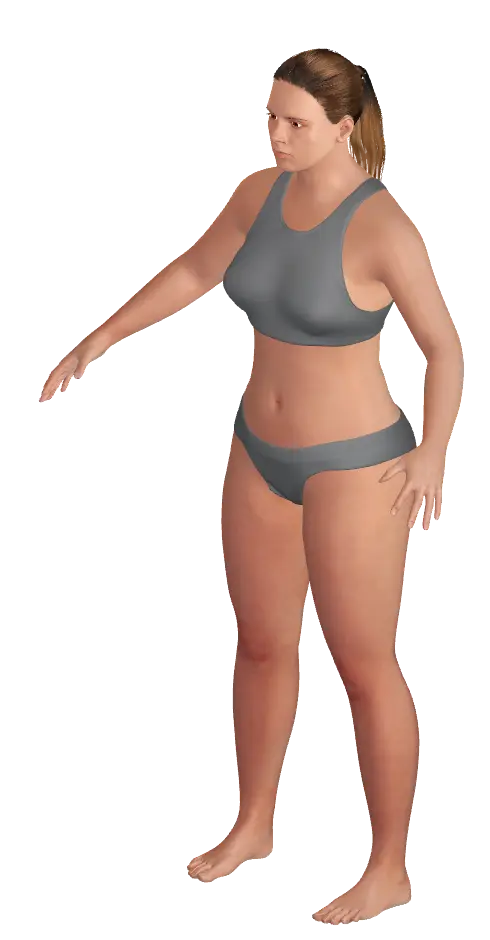
This preview is an estimate from a parametric 3D body model. It is not a body scan or a medical assessment.
What you can measure. All on one body.
- Weight
- Neck
- Chest
- Waist
- Thigh
- Shoulder girth
- Arm
- Wrist
- Hip
- Calf
Left and right · Your own spots
Turn it around in the app
In Contura this body turns any way you like. Log your measurements each week and it changes with you, so you can put any two dates side by side.
Download ConturaSources
- Heart-Healthy Living: Aim for a Healthy Weight (Measuring waist circumference) National Heart, Lung, and Blood Institute (NIH), last updated 11 December 2025
- Incentives for Nondiscriminatory Wellness Programs in Group Health Plans (final rules) Departments of Labor, Health and Human Services and the Treasury, Federal Register, 3 June 2013