
How to measure your waist for the military WHtR
Army, Navy and Marine Corps: tape level across the navel. Air Force: tape at the midpoint between your lowest rib and the top of your hip bone. Every branch measures on bare skin, standing relaxed, at the end of a normal breath out, and records waist and height in inches rounded to the half inch (down for the waist).
The method, branch by branch
- 1Army, Navy and Marine Corps: level across the navel
- 2Air Force and DoW Instruction 1308.03: midpoint between the lowest rib and the top of the hip bone
- Lowest rib · Top of hip bone
Approximate positions on a 3D body. Follow the method your assessor uses.
| Army | Navy | Air Force | Marine Corps | |
|---|---|---|---|---|
| Where | At the navel | At the navel, from the right side | Midpoint between lowest rib and top of hip bone, from the right side | Over the navel |
| Readings | Not stated in the directive | 2 (3rd if more than 1″ apart) | 3 (4th if more than 1″ apart) | Not stated in the quick guide; self-tensioning tape |
| Waist rounding | Down to ½″ (DoWI 1308.03) | Down to ½″ | Down to ½″ | Down to ½″ |
| Height rounding | Down to ½″ (DoWI 1308.03) | Up to ½″ | Nearest ½″ | Down to ½″ |
| Ratio | Below 0.55 | Rounded down to 4 decimals, 0.5499 or less | Truncated to 2 decimals, high risk above .55 | Rounded at 5th decimal, 0.52 or less |
The Army directive names the navel but does not spell out readings or rounding; DoW Instruction 1308.03 requires every service to record in inches rounded down to the nearest half inch. Your unit’s trained measurers follow the Army’s implementing guidance.
Measuring yourself at home
- Find your spot. For the navel method, the tape crosses the middle of your belly button. For the Air Force method, feel for the bottom of your lowest rib and the top of your hip bone at your side, and put the tape halfway between them.
- Stand like you will on the day. Feet no wider than your shoulders, weight even, head level, arms relaxed at your sides. Do not hold the tape in place when you read it.
- Keep the tape level. It should be parallel to the floor all the way round. A mirror or a second person helps; the back is where it usually dips.
- Snug, not tight. On bare skin, touching all the way round without pressing in.
- Read at the end of a normal breath out. Not after a deep exhale, and without pulling in your stomach.
- Repeat and round down. Take two or three readings, round each down to the half inch, and average them the way your branch does.
Measure height without shoes, heels, buttocks and shoulder blades against a wall, with a flat object level on top of your head, as the Marine Corps guide shows.
Make home readings comparable
Waist size moves through the day with meals, fluid and bloating, so the trend is only useful if conditions match. Pick one time, for example in the morning before eating, and keep it. Use the same tape. Write down each reading with the date. A change of a quarter inch between two days is usually noise; a steady move over three or four weeks is real.
Once you have a reading, the calculator applies your branch’s rounding, and standards by branch explains what happens above the line.
Questions people ask
Where is the waist measured for the military WHtR?
It depends on the branch. The Army, Navy and Marine Corps measure across the navel (belly button). The Air Force and DoW Instruction 1308.03 use the midpoint between the lowest rib and the top of the hip bone, which is usually at or just above the navel.
Is the waist measured over clothing?
No. The Navy, Air Force and Marine Corps procedures all put the tape on bare skin. Your shirt is held or moved out of the way and your arms hang at your sides when the reading is taken.
How many times is the waist measured?
Air Force: three readings, averaged, with a fourth if any differ by more than an inch. Navy: two readings, with a third if they differ by more than an inch, averaging the two closest. The Marine Corps quick guide specifies a self-tensioning tape on bare skin but does not state a number of readings.
Can I hold my breath or suck in?
No. Readings are taken at the end of a normal breath out, and the Navy turns a Sailor away for 72 hours if it sees signs of an altered measurement. Measuring honestly at home is also the only way your own numbers will predict the official one.
What tape should I use at home?
A non-stretch tape marked in inches. A self-tensioning tape (the kind with a spring button) helps you apply the same pressure every time, which is what the Marine Corps uses.
Your body in 3D
Your waist-to-height ratio, as a body
Add your height, weight and waist to see a body like yours from Contura’s 3D model. In the app, every reading updates the body and your ratio, measured the same way each week.
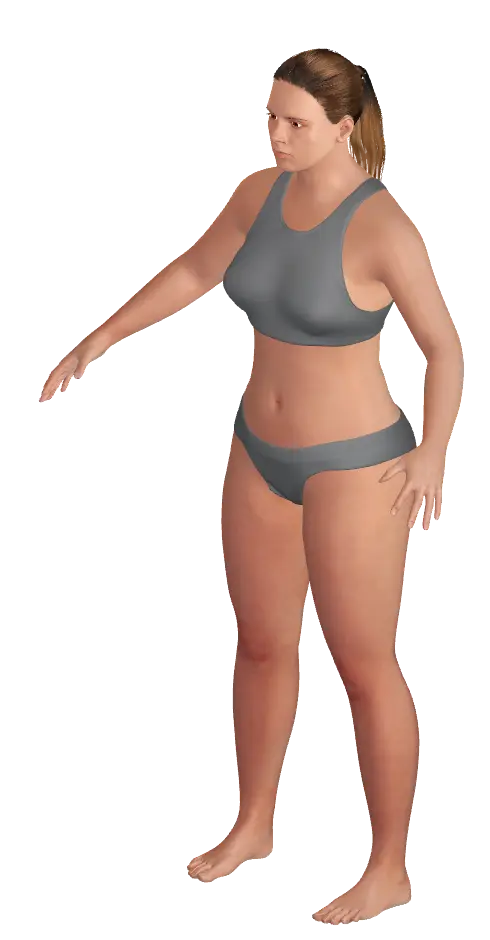

This preview is an estimate from a parametric 3D body model. It is not a body scan or a medical assessment.
What you can measure. All on one body.
- Weight
- Neck
- Chest
- Waist
- Thigh
- Shoulder girth
- Arm
- Wrist
- Hip
- Calf
Left and right · Your own spots
Turn it around in the app
In Contura this body turns any way you like. Log your measurements each week and it changes with you, so you can put any two dates side by side.
Download ConturaSources
- DoW Instruction 1308.03, DoW Physical Fitness/Body Composition Program Effective 31 August 2026; incorporates and cancels the December 2025 memorandum
- Army modifies Body Composition Program, adopts Waist-to-Height Ratio Army Public Affairs, army.mil, 7 July 2026
- The full measure: The Army’s new WHtR standard U.S. Army Sustainment Command, army.mil, 18 September 2026
- Navy Physical Readiness Program Guide-4: Body Composition Assessment (BCA) MyNavy HR, OPNAV N171, June 2026
- DAFMAN 36-2905, Air Force Physical Fitness Readiness Program Department of the Air Force, 24 March 2026; applies to the Regular Air Force, Reserve and Air National Guard, not the Space Force
- Waist-to-Height Ratio (WHtR) Quick Guide (USMC procedural guidance) USMC Human Performance Branch, published 1 September 2026, supporting MARADMIN 073/26