
Waist-to-height ratio standards by branch, and what happens over the line
The Department of War caps the ratio below 0.55 (DoW Instruction 1308.03, 31 August 2026). What happens above the line depends on your branch:
- Army: 0.55 or more on two same-day measurements means a flag and the Army Body Composition Program. No body fat test can overturn it.
- Navy: 0.5500 or more goes to a body fat estimate. Above 26% (men) or 36% (women) is a failed PFA cycle.
- Air Force: above .55 and a failed composite fitness assessment means a second body fat assessment.
- Marine Corps: above 0.52 goes to a body fat evaluation (tape or bioimpedance). Failing both means the Body Composition Program.
The DoW-wide rule
On 18 December 2025 the Under Secretary of War for Personnel and Readiness ordered the services to use the waist-to-height ratio from 1 January 2026 and to stop using height and weight tables. DoW Instruction 1308.03, effective 31 August 2026, now carries those rules:
- The upper limit is less than 0.55. A service may set its own line at or below that.
- Waist is measured at the midpoint between the lowest rib and the top of the hip bone, standing and breathing normally, with a non-stretch tape parallel to the floor. Measurements are recorded in inches, rounded down to the nearest half inch.
- A ratio of 0.55 or above, or above the service’s own line, leads to a body fat calculation. Service body fat standards may be no stricter than 18% (men) and 26% (women) and no looser than 26% and 36%.
- Members over the body fat standard enter their service’s remedial program and are referred for a medical evaluation. Failing to meet standards can hold back promotions, and continued failure can lead to administrative separation.
- Active duty is assessed twice a year; Guard and Reserve members do it with their annual fitness assessment.
The services wrote their own rules within that frame, and they are not identical.
Army
Army Directive 2026-13, signed 1 July 2026, applies to the Regular Army, Army National Guard and Army Reserve, and to cadets.
- Line: a ratio “less than and not equal to 0.55”. Waist is measured at the navel.
- Over the line: a second team re-measures you on the same duty day before your commander acts. At 0.55 or more you are flagged and enrolled in the Army Body Composition Program (ABCP).
- No second method: the tape test and other body fat assessments may not be used to challenge the ratio, and no Army Fitness Test score exempts you.
- In the program: monthly progress checks were rescinded. Your commander decides when to re-measure you, and you are removed as soon as you meet the standard. Regular Army and AGR Soldiers get a medical examination; Guard and Reserve Soldiers may request one, at their own expense when not on active duty.
- Timing: at least twice per calendar year, at least 7 days apart from the AFT or CFT, and at any time your commander directs.
- Separations: units may start separation actions, but no Soldier will be separated for ABCP failure until HQDA completes its 180-day assessment and issues further guidance.
One open question: the Army directive (July 2026) allows no body fat step, while DoW Instruction 1308.03 (August 2026) calls for a body fat calculation at 0.55 or above. The Army has two years to fold the directive into AR 600-9. Until it does, ask your unit which applies to you.
Navy
Navy Physical Readiness Program Guide-4 (June 2026) sets a two-step body composition assessment (BCA). Height, waist and weight are all recorded for every Sailor.
- Step 1: waist (at the belly button) divided by height, rounded down to four decimals. 0.5499 or less is within standards.
- Step 2: at 0.5500 or more, body fat is estimated from the height-minus-waist difference and weight using the Guide-4 tables. The limits are 26% for men and 36% for women.
- Over both: the BCA is not within standards and the whole PFA is recorded as a failure for that cycle, unless you qualify for the high-performance BCA exemption in Guide-1. You still take the PRT or CFT, after medical clearance.
- No substitutes: calipers, bioimpedance, BMI or underwater weighing are not accepted, and a medical waiver cannot reverse an official BCA afterwards.
Air Force
DAFMAN 36-2905 (24 March 2026) covers the Regular Air Force, the Air Force Reserve and the Air National Guard. It does not cover the Space Force.
- Scoring: body composition is one of four components, worth 20 of 100 points, and has no component minimum. The ratio is truncated to two decimals.
- High risk: a ratio above .55. If you are above .55 and do not meet the composite fitness standard, you complete a Tier 2 body fat assessment, using an InBody 770 bioimpedance scale where available, or otherwise a two- or three-site tape method.
- Remedial program: members above .55 who do not meet the body fat standard are enrolled in the Fitness Reconditioning Program (FRP).
- 2026 baseline: in July 2026 every Airman had to record a ratio in the myBodyComp app by 31 July (Reserve components by 31 August). The Air Force said this one-time measurement does not affect fitness scores or personnel actions.
Marine Corps
The Marine Corps procedural guidance (September 2026, supporting MARADMIN 073/26) sets the strictest line.
- Line: a ratio of 0.52 or less, for men and women alike, measured across the navel.
- Over the line: a body fat evaluation by either the multi-site tape test or bioimpedance (BIA). If a BIA device is available you choose which comes first; you need to pass one. Failing both means processing for the Body Composition Program (BCP).
- Performance allowance: a PFT and CFT score of 250 or more adds 1% to your maximum allowable body fat; 285 or more gives the most permissive allowance, 26% for men and 36% for women.
- Who measures: only Command PT Representatives or Force Fitness Instructors of the same sex as the Marine, twice a year.
Space Force and Coast Guard
This page covers the four services whose current documents we could read in full. The Space Force is outside DAFMAN 36-2905 and the Coast Guard sits outside the Department of War. Check your own service’s current guidance.
If you are close to the line
Waist changes slowly, and the official reading is rounded down to half inches, so a quarter inch can decide the result. Measure yourself the same way your assessor does (see how to measure), at the same time of day, every week or two, and look at the trend rather than one reading. The calculator shows the largest waist that meets your branch’s line at your height. For a plan to change it, the Army article above points Soldiers to their unit Master Fitness Trainer and a registered dietitian; other branches have equivalent fitness and nutrition staff.
Questions people ask
What happens if my waist-to-height ratio is 0.55 or more in the Army?
A different team re-measures you the same duty day. If you are still at 0.55 or above, you are flagged and enrolled in the Army Body Composition Program. No tape test or other body fat method can be used to challenge the result, and you leave the program as soon as you meet the standard.
Can I be separated for failing the WHtR?
Every branch can eventually start administrative separation for continued failure; DoW Instruction 1308.03 allows it. In the Army, Army Directive 2026-13 says no Soldier will be separated for ABCP failure until Headquarters, Department of the Army completes a 180-day assessment and issues further guidance.
What body fat limits apply after the ratio in the Navy?
Navy Guide-4 (June 2026) allows up to 26 percent body fat for men and 36 percent for women in step 2, estimated from height, waist and weight. Above that, the body composition assessment is not within standards and the PFA is recorded as a failure for the cycle, unless the high-performance exemption applies.
Does the Air Force score the waist-to-height ratio?
DAFMAN 36-2905 (24 March 2026) makes it the body composition component, worth 20 of 100 points. The July 2026 myBodyComp measurement was a one-time baseline that the Air Force said does not affect fitness scores. Check with your Fitness Assessment Cell for how your next assessment is scored.
How often is body composition checked?
Twice a year for active duty under DoW Instruction 1308.03. Guard and Reserve members complete it with their annual fitness assessment. Army commanders can also order a check at any time.
Your body in 3D
Near the line? See where you stand
Add your height, weight and waist to see a body like yours. Logging each week in the app shows whether you are moving toward the line or away from it, and where on your body.
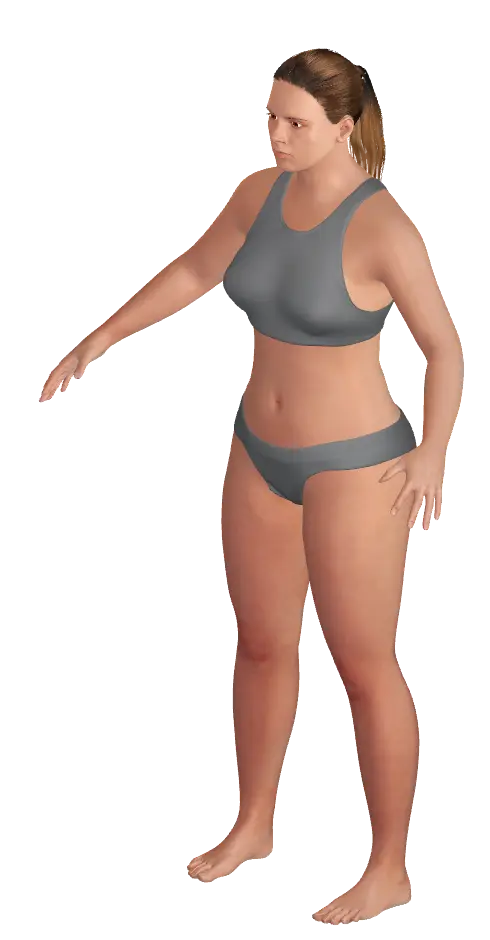

This preview is an estimate from a parametric 3D body model. It is not a body scan or a medical assessment.
What you can measure. All on one body.
- Weight
- Neck
- Chest
- Waist
- Thigh
- Shoulder girth
- Arm
- Wrist
- Hip
- Calf
Left and right · Your own spots
Turn it around in the app
In Contura this body turns any way you like. Log your measurements each week and it changes with you, so you can put any two dates side by side.
Download ConturaSources
- DoW Instruction 1308.03, DoW Physical Fitness/Body Composition Program Effective 31 August 2026; incorporates and cancels the December 2025 memorandum
- Additional Guidance on Military Fitness Standards (memorandum) Under Secretary of War for Personnel and Readiness, signed 18 December 2025; WHtR from 1 January 2026
- Army Directive 2026-13 (Army Body Composition Program and Standards) Secretary of the Army, 1 July 2026; listed on the Army Publishing Directorate directives page
- Army modifies Body Composition Program, adopts Waist-to-Height Ratio Army Public Affairs, army.mil, 7 July 2026
- The full measure: The Army’s new WHtR standard U.S. Army Sustainment Command, army.mil, 18 September 2026
- Navy Physical Readiness Program Guide-4: Body Composition Assessment (BCA) MyNavy HR, OPNAV N171, June 2026
- DAFMAN 36-2905, Air Force Physical Fitness Readiness Program Department of the Air Force, 24 March 2026; applies to the Regular Air Force, Reserve and Air National Guard, not the Space Force
- Air Force launches myBodyComp, reinforces July 31 deadline for waist-to-height ratio measurements Secretary of the Air Force Public Affairs, af.mil, 23 July 2026
- Waist-to-Height Ratio (WHtR) Quick Guide (USMC procedural guidance) USMC Human Performance Branch, published 1 September 2026, supporting MARADMIN 073/26
- Body Composition Program Standards USMC Human Performance Branch, fitness.marines.mil (checked 15 November 2026)