
How many pounds to lose an inch off your waist?
About 5 pounds for men and 6 pounds for women, on average. A study that followed 2,635 adults for a year found that every 3 kg (6.6 lb) lost took 3.45 cm off men’s waists and 2.83 cm off women’s. So 10 pounds is roughly 1.7 to 2 inches. Your own number can be quite different, which is why it’s worth measuring.
about 1.7 in off your waist
from 10 lb lost, at the average rate
- Per inch of waist
- ≈ 5.9 lb
- At 2 lb a week
- 5 weeks
- At 1 lb a week
- 10 weeks
Average from a one-year study of 2,635 adults (waist measured at the navel). Your own number can be half or double this: people lose from different places first.
Where the numbers come from
Researchers in Okayama, Japan, measured the weight and waist of 2,635 adults (average age 40) and measured them again a year later. Changes in weight and changes in waist moved together: 3 kg less body weight went with 3.45 cm less waist in men and 2.83 cm in women, measured at the level of the navel. That works out to about 4.9 lb per inch for men and 5.9 lb per inch for women, which is what the calculator uses.
Men tend to lose more from the waist for the same weight because more of their fat sits around the middle. Women more often carry it on the hips and thighs too, so part of their loss shows up there instead.
Why your number may be different
- Where you store fat. If your waist is where you gain first, it is often where you lose first too.
- Muscle. If you start lifting, you can lose fat and gain some muscle, so your waist goes down while your weight barely moves. In a six-month trial of 411 women, waists shrank in every exercise group regardless of weight change, and the link between the two was weak.
- Water and food in your gut. Salt, carbs, a big meal or your cycle can change your waist by an inch from one day to the next. Measure at the same time of day, before eating.
- The first few pounds. Early weight loss is partly water, so the scale often moves before the tape does.
How long it takes
The CDC suggests losing about 1 to 2 pounds a week: people who lose at that steady pace are more likely to keep it off. At that pace one inch takes about 3 to 6 weeks, and 2 inches about 5 to 12 weeks.
Measure it the same way every time
The study measured at the navel. You can measure there or halfway between your lowest rib and the top of your hip bone, but use the same place every time, breathe out normally, and keep the tape level. No tape at home? A string and your iPhone work: see how to measure your waist without a tape measure. If your weight has stalled but your clothes feel looser, see why you can lose inches but not weight.
Questions people ask
How much weight do you have to lose to lose an inch off your waist?
On average about 5 lb for men and 6 lb for women. In a study that followed 2,635 adults for a year, every 3 kg (6.6 lb) lost took 3.45 cm off men’s waists and 2.83 cm off women’s, measured at the navel. Individual results vary a lot.
How many inches is 10 pounds?
About 1.7 inches off the waist for a woman and about 2 inches for a man, at the average rate. Some people lose more from the waist first, others from the hips, thighs or face.
How many inches off your waist is 20 pounds?
Roughly 3.4 inches for a woman and 4 inches for a man on average. At the 1 to 2 pounds a week the CDC suggests, 20 pounds takes about 10 to 20 weeks.
Can you lose 2 inches off your waist in a month?
It is at the fast end. Two inches is about 10 to 12 pounds at the average rate, which is a month at 2 to 3 pounds a week. At the CDC’s steady pace of 1 to 2 pounds a week, expect 5 to 12 weeks. Water and bloating can move your waist by an inch from day to day, so compare measurements taken at the same time of day.
Can I lose inches without losing weight?
Yes. In a six-month exercise trial, women’s waists shrank in every exercise group whether or not their weight dropped, and weight change and waist change were only weakly linked. This is why measuring your waist tells you things the scale can’t.
Your body in 3D
See the inches on a body
Set your height and weight, then a lighter weight, to see the closest body from Contura’s 3D model. In the app the body follows the waist you actually measure.
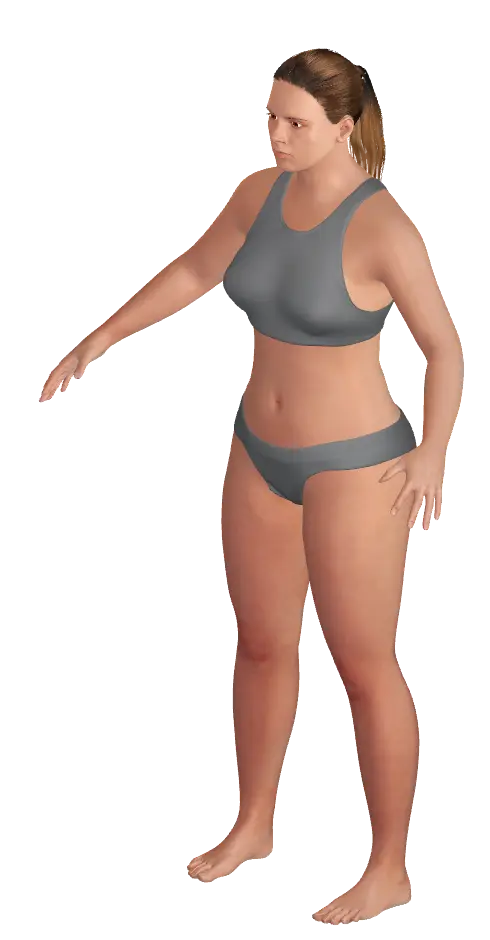

This preview is an estimate from a parametric 3D body model. It is not a body scan or a medical assessment.
What you can measure. All on one body.
- Weight
- Neck
- Chest
- Waist
- Thigh
- Shoulder girth
- Arm
- Wrist
- Hip
- Calf
Left and right · Your own spots
Turn it around in the app
In Contura this body turns any way you like. Log your measurements each week and it changes with you, so you can put any two dates side by side.
Download ConturaSources
- Relationship between changes in body weight and waist circumference in Japanese Miyatake N et al., Environmental Health and Preventive Medicine 2007;12(5):220–223. 2,635 adults followed for 1 year; waist at the navel
- Changes in Weight, Waist Circumference and Compensatory Responses with Different Doses of Exercise among Sedentary, Overweight Postmenopausal Women Church TS et al., PLoS One 2009;4(2):e4515. 411 women, 6 months
- Steps for Losing Weight CDC, Healthy Weight and Growth: "about 1 to 2 pounds a week" (read 17 November 2026)